
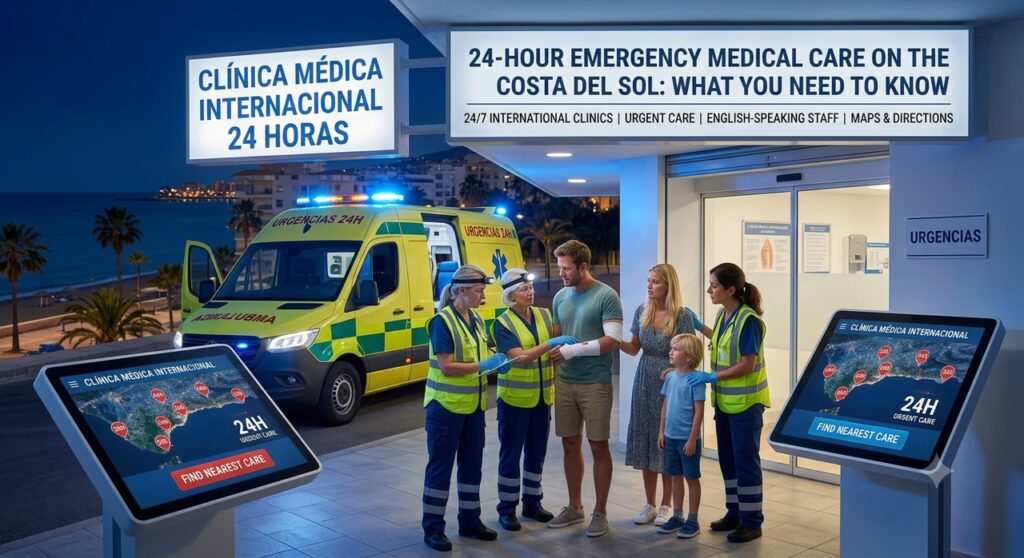
It’s 2 AM, and you or someone in your family experiences severe chest pain, difficulty breathing, or a serious injury. Your first thought isn’t about tourism or relaxation—it’s survival.
The question is: do you know where to go?
Whether you’re a tourist vacationing on the Costa del Sol or an expat living here, understanding how to access 24-hour emergency medical and urgent medical care can be the difference between panic and peace of mind.
The good news: the Costa del Sol has excellent emergency medical infrastructure. Private clinics operate 24/7 and handle everything from minor injuries to serious emergencies. Most have English-speaking staff and modern equipment. The challenge is knowing where to go and how fast you can get there.
In this guide, we’ll clarify the Spanish emergency system, explain the difference between urgent care and emergency care, and show you exactly how to access round-the-clock medical services on the Costa del Sol.
Emergency vs. Urgent Care: Know the Difference
In Spain (and most of Europe), there’s a critical distinction between emergencies and urgent care. Understanding this distinction determines where you go and how quickly you’ll be seen.
Emergency (Life-Threatening)
Definition: Conditions that pose immediate danger to life.
Examples:
- Severe chest pain or pressure
- Difficulty breathing or choking
- Loss of consciousness
- Severe bleeding or trauma
- Allergic reactions with difficulty breathing
- Sudden severe headache with stiff neck
- Suspected stroke or heart attack
What to do: Call emergency services immediately (112 in Spain) or go to a hospital emergency department (Urgencias). These are free or covered by travel insurance in most cases.
Response time: Ambulance arrives within 10-15 minutes in urban areas.
Urgent Care (Time-Sensitive)
Definition: Conditions that require medical attention within hours but are not immediately life-threatening.
Examples:
- High fever in children or adults
- Severe infections (ear, urinary, throat)
- Moderate to severe injuries or fractures
- Severe allergic reactions without respiratory distress
- Dehydration or heat exhaustion
- Minor burns
- Suspected appendicitis
- Moderate pain that’s interfering with function
What to do: Visit an urgent care clinic or private medical center. These can often see you same-day or within a few hours.
Response time: Private clinics typically see urgent cases within 30 minutes to 2 hours.
Cost: Private urgent care costs €50-150 depending on the clinic and services required.
How to Access 24-Hour Medical Care: Your Options
Option 1: Emergency Services (112)
When to use: Life-threatening situations only.
How it works:
- Call 112 from any phone (mobile or landline)
- Explain your emergency in English, Spanish, or other languages
- Dispatcher will send an ambulance or guide you to nearest hospital
- Ambulance arrives and transports you to the hospital’s emergency department
Wait time: 10-15 minutes for ambulance arrival in urban areas; emergency department wait time varies (30 minutes to 2+ hours depending on volume)
Cost: Free if you’re an EU resident with EHIC (European Health Insurance Card) or have valid travel insurance. Non-insured patients pay hospital rates (can be expensive).
Important: Call 112 only for true emergencies (chest pain, difficulty breathing, severe bleeding, unconsciousness, etc.). Calling for minor issues strains emergency services.
Option 2: Private Urgent Care Clinics (24/7)
When to use: Non-life-threatening but time-sensitive medical needs.
How it works:
- Call the clinic directly or walk in during off-hours
- Explain your symptoms briefly
- Clinic staff will assess urgency and fit you in
- You’re seen by a doctor typically within 30 minutes to 2 hours
- Diagnosis, treatment, and prescription handling on-site
Wait time: 30 minutes to 2 hours depending on volume
Cost: €50-150 per consultation, depending on clinic and services
Advantages:
- No language barrier (English-speaking staff)
- Modern equipment and facilities
- Prescription written and dispensed same-day
- Can obtain medical certificates
- Predictable cost (no surprise bills)
Access Läkare Internacional’s 24-hour emergency care clinic in Nerja, Benalmádena, and other Costa del Sol locations. Same-day appointments for non-emergency urgent care.
Option 3: Telehealth or Video Consultation (24/7)
When to use: Moderate symptoms where you need medical advice but don’t need physical examination.
Examples:
- Recurring symptoms you want assessed
- Prescription refills needed
- Travel health questions
- Minor skin concerns
How it works:
- Call or use app to connect with English-speaking doctor
- Describe symptoms via video
- Doctor provides assessment and can email prescriptions
- Typically charged €40-80
Wait time: 5-30 minutes
Limitations: No physical examination, so can’t diagnose certain conditions.
What to Do If You Experience a Medical Emergency
If it’s life-threatening:
Step 1: Call 112 immediately
- Say «ambulancia, por favor» (ambulance, please)
- Clearly state your location
- Follow dispatcher instructions
- Stay on the line
Step 2: While waiting for ambulance
- Keep the person calm and lying down
- Don’t move if serious injury is suspected
- Monitor breathing and consciousness
- Perform CPR if trained and person is unresponsive
Step 3: Go to hospital
- Ambulance will transport to nearest hospital
- Hospital emergency department (Urgencias) handles immediate care
If it’s urgent but not immediately life-threatening:
Step 1: Access immediate private urgent care
- Call a 24-hour private clinic directly
- Or walk into an urgent care center
- Explain symptoms: «I need urgent care»
Step 2: Transport to clinic
- If you can drive safely, go directly to the clinic
- If mobility is limited, call clinic and ask if ambulance transport is available
- Some private clinics have partnerships with transport services
Step 3: Get assessed and treated
- Doctor will examine, diagnose, and treat
- Prescriptions provided same-day
- Medical documentation given if needed
24-Hour Private Clinics on the Costa del Sol
Several private clinics operate 24/7 specifically for tourists and expats. The main locations are:
Nerja:
Private urgent care clinics in Nerja serve tourists and residents 24 hours daily. English-speaking doctors handle everything from injuries sustained at the beach to infections. Learn about emergency care options in Nerja.
Benalmádena:
Benalmádena’s high tourist traffic means private clinics here are experienced with international patients and operate round-the-clock. Most offer walk-in urgent care. Find 24-hour urgent care in Benalmádena.
Other locations:
Private clinics also operate in Marbella, Almuñécar, and along the coast. Search online for «urgencias privadas [city name]» or ask your hotel concierge.
Important Things to Know About Spanish Healthcare in Emergencies
Language Assistance
Spanish public hospitals have English-speaking staff, but availability varies. Private urgent care clinics always have English-speaking doctors—this is a major advantage for international patients.
Medical Records
When you visit a private clinic, ask for documentation of:
- Doctor’s name and qualifications
- Diagnosis
- Treatment provided
- Prescriptions issued
- Recommended follow-up
Keep these records. They’re valuable if you need follow-up care or if you travel.
Medications and Pharmacy
Medications are not covered automatically. You’ll pay for prescriptions out of pocket at a pharmacy. Spanish pharmacies use the generic name for medications, which may differ from your home country. Ask your doctor for the active ingredient name if concerned.
Example: «Paracetamol» is what Spain calls acetaminophen/paracetamol. They’re the same drug.
Travel Insurance
If you’re a tourist, travel insurance should cover urgent medical care. Check your policy:
- Does it cover private urgent care clinics?
- Is there a deductible?
- Do they reimburse directly or do you pay first and claim later?
Having this information before emergencies happen prevents surprise bills.
Frequently Asked Questions About Emergency Care on Costa del Sol
What do I do if I experience a medical emergency at night or on a weekend?
Private urgent care clinics operate 24/7, including weekends and holidays. Call directly or walk in. For life-threatening emergencies, call 112.
Will I understand the doctor if I don’t speak Spanish?
Private clinics have English-speaking staff. Public hospital emergency departments have translators or bilingual staff, but wait times may be longer. Private clinics are faster for international patients.
How much will emergency care cost?
Private clinics charge €50-150 per urgent consultation. Hospitals vary; without insurance, bills can be €500-2,000+ depending on services. Travel insurance typically covers this.
Can I get a medical certificate or documentation for my records?
Yes. Private clinics provide official documentation. Request it at the time of visit or ask when calling ahead.
What if I need prescription medications after hours?
Some pharmacies operate 24/7 in larger towns. Private clinics can dispense common medications directly, or provide prescriptions to be filled the next day.
Do private clinics accept health insurance from my home country?
Some do, but policies vary. Contact your insurance provider to confirm what’s covered in Spain. Many private clinics accept payment and you claim reimbursement later.
Before You Need Emergency Care: Prepare Now
Save important information:
- Emergency number: 112 (universal in Spain)
- Name and location of nearby private urgent care clinic
- Your insurance policy number and emergency contact number
- Any allergies or medications you’re currently taking
- Blood type (if you know it)
Tell someone where you are:
- If traveling, inform your hotel staff or travel companion where you’ll be
- This speeds up emergency response if something happens
Know your travel insurance:
- Understand what’s covered
- Have policy number accessible
- Know how to claim
Conclusion
While nobody plans for medical emergencies during their time on the Costa del Sol, knowing how to access care transforms anxiety into confidence. The Costa del Sol has world-class private medical services available 24/7, with English-speaking doctors and modern facilities.
The key: Identify your nearest urgent care clinic before you need it. Save the phone number. Know the difference between emergency (call 112) and urgent care (private clinic). And remember—if you ever doubt whether something is serious, err on the side of caution and seek professional evaluation.
Läkare Internacional provides 24-hour emergency and urgent medical care across the Costa del Sol. Same-day appointments, English-speaking doctors, and comprehensive medical services. When you need immediate care, we’re here.
Stay healthy, stay prepared, and enjoy your time on the Costa del Sol.